
Obstetric (OBS) Scan in Pregnancy | Purpose, Timing, Procedure, and Cost
Pregnancy involves a series of medical ultrasounds to monitor the health and development of both mother and baby. An OBS scan (Obstetric Ultrasound/Scan) refers to ultrasound examinations performed during pregnancy to assess fetal growth, development, position, and overall well-being.
These scans are a routine and essential part of prenatal care. They provide important information at different stages of pregnancy and help you guide ongoing medical management.
Plan Your OBS Scan with a Trusted Specialist at Clinic One
What Is an OBS Scan?
An Obstetric (OBS) scan is an ultrasound examination performed during pregnancy to monitor your baby’s health and development. It uses high-frequency sound waves (not radiation) to create real-time images of the fetus, placenta, and uterus.
In simple terms, it’s the primary imaging tool doctors use to safely and accurately track your pregnancy.
The term “OBS scan” is broad. It includes different types of pregnancy ultrasounds done at various stages. These include early pregnancy scans to confirm viability, NT scans to assess early risk markers, anomaly scans to evaluate anatomy, growth scans in the third trimester, and, if needed, Doppler ultrasound or studies to assess blood flow.
Who Should Get an OBS Scan?
Every expecting mother should have these scans as part of routine prenatal care, but certain circumstances make them especially important, like a past pregnancy complication, unexplained symptoms, and high-risk pregnancies.
- Routine prenatal monitoring: Doctors schedule OBS scans for all pregnant women to track healthy growth and development.
- Previous pregnancy complications: Women who experienced miscarriages, preterm births, or growth issues receive additional attention.
- High-risk pregnancies: Conditions like diabetes, hypertension, or autoimmune disorders require closer monitoring.
- Multiple pregnancies: Twins or higher-order multiples need detailed assessment to track each baby’s growth and position.
- Unexplained symptoms: If mothers experience bleeding, pain, or reduced fetal movement, doctors perform scans promptly to ensure safety.
When Can You Have an OBS Scan?
Healthcare providers schedule your obstetric (OB) ultrasounds at specific stages of pregnancy to monitor fetal growth and development. They typically perform the first scan between 6 and 14 weeks of gestation and conduct a detailed anatomy scan around 18 to 22 weeks.
In addition to routine ultrasounds, your obstetric gynecologist might recommend extra scans when you have high-risk conditions or a history of pregnancy complications.
OBS Scan and Pregnancy Ultrasound Schedule
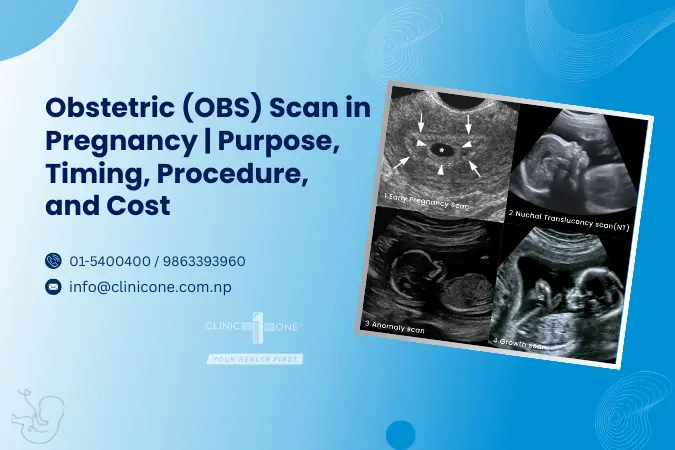
A typical pregnancy ultrasound schedule includes multiple OBS scans at different stages. Each stages of these scans have a clear medical purpose. Typically, routine prenatal care revolves around four main OBS scan stages: early pregnancy, nuchal translucency (NT) scan, anomaly scan, and growth scan.
Early Pregnancy / Dating Scan at 6-11 Weeks
The very first scan confirms that the pregnancy is developing normally. In the earliest weeks, doctors often use a transvaginal ultrasound approach to get clearer images of the tiny developing baby. It checks for:
-
- Fetal heartbeat (viability)
- Number of fetuses (single or multiple)
- Accurate due date
Nuchal Translucency (NT) Scan at 11-14 Weeks
The NT scan looks for early markers of chromosomal conditions like Down syndrome by measuring the fluid at the back of the baby’s neck.
-
- Timing is precise: between 11 weeks 4 days and 13 weeks 6 days
- Often paired with first-trimester blood tests for more accurate risk assessment
Fetal Anomaly / Morphology Scan at 18-22 Weeks
An anomaly scan is the detailed mid-pregnancy scan everyone talks about. It provides one of the most complete pictures of fetal health in pregnancy and helps detect structural abnormalities early. These scans check:
-
- Organs and bones
- Spine, face, and limbs
- Placenta, amniotic fluid, and cervix
Growth and Wellbeing Scan at 24-42 Weeks
As the baby grows, these scans help doctors monitor size, weight, and overall well-being. It tracks and checks fetal growth patterns, estimated weight, and the baby’s position before delivery (usually around 32-36 weeks). Apart from these, growth scans also focus on:
-
- Amniotic fluid levels
- Blood flow via Doppler
What Does an OBS Scan Check?
An OBS scan checks the baby’s growth, development, and overall health, along with key aspects of the pregnancy that support a healthy outcome.
Depending on the stage of pregnancy, it evaluates:
- Fetal heartbeat: The scan checks the baby’s heartbeat, ensuring it is beating at a normal rate.
- Gestational age and growth: It measures the baby’s head, belly, and limbs to track growth and estimate the due date.
- Fetal anatomy: It checks the baby’s brain, heart, spine, stomach, kidneys, arms, legs, and face (especially during the mid-pregnancy anomaly scan).
- Placenta: The scan checks where the placenta(the organ that feeds the baby in the womb) is and whether it is working properly.
- Amniotic fluid levels: This ensures the baby has the right environment for development.
- Fetal position: Identifies whether the baby is head-down, breech, or lying sideways later in pregnancy.
- Blood flow (Doppler, if needed): Doppler ultrasound evaluates umbilical, uterine, and fetal circulation in high-risk pregnancies.
How is the OBS Scan Performed?
A trained sonographer or doctor performs the OBS scan in a clinic or hospital setting.
During the scan:
- First, the patient lies comfortably on the examination bed.
- Then, the sonographer applies a clear, water-based gel on the abdomen so the device can move smoothly and give clear images.
- Next, the sonographer gently moves a handheld transducer over the belly.
- As the transducer sends sound waves into the body, live images of the baby appear on the monitor.
- Then, the sonographer studies the images and takes measurements or photos as needed.
- Finally, the scan ends once all necessary images and measurements are collected.
The length of the scan depends on its purpose. Early pregnancy scans usually take 10-20 minutes. A detailed mid-pregnancy scan may take 30 minutes or longer, especially if the baby’s position makes it harder to see certain parts clearly.
Sometimes, especially in early pregnancy, the doctor prefers a TVS (transvaginal) scan. In this case, a thin, covered probe is gently inserted into the vagina to see the uterus and baby more clearly. This scan may cause mild discomfort but is usually not painful.
Price of an OBS Scan in Nepal
In Nepal, OBS scan prices in Nepal generally start from approximately Rs. 1500-4000, depending on:
- Stage of pregnancy
- Type of scan (early, anomaly, growth)
- Facility and location
- Technology used
The exact prices may vary between clinics and cities.
How to Choose the Right Obs Scan Centres in Kathmandu?
Many hospitals and diagnostic centres in Kathmandu offer obstetric ultrasound services. But choosing the right ultrasound clinic is important as it helps ensure accurate results, safety, and a smooth experience. While finding options, do check if the centre has trained and experienced staff, including radiologists or sonographers who specialise in pregnancy scans.
Consider the experience of the clinic or hospital, as centres with years of practice are more reliable. Apart from these, other important factors include:
- Ultrasound equipment quality: Modern machines give clearer images and more accurate assessments.
- Reporting system: The centre should provide detailed reports and images that can be shared with your doctor.
- Appointment availability: Flexible scheduling makes the process easier and less stressful.
Among the many options in Kathmandu, Clinic One Jawalakhel’s ultrasound services stand out as a reliable choice. It combines experienced staff, years of clinic expertise, advanced ultrasound technology, and detailed reporting, making it convenient and reassuring for expectant parents.
How You Benefit from OBS Scans at One Ultrasound, Jawalakhel?
- Rest assured in the hands of a radiologist with decades of experience.
- Benefit from nearly a decade of expert prenatal care.
- Skip long waits with our easy, flexible appointment scheduling.
- We use advanced, high-precision GE ultrasound machines.
- Feel safe in a thoroughly clean and hygienic environment.
- You’ll get your scan results quickly, without delay.
- Enjoy high-quality OBS scans at prices that suit your budget.
- Receive clear explanations from the doctor to understand your baby’s development.
- Join thousands of expectant parents who have trusted the clinic for their OBS scans over the years.
- Join the many who trust a clinic recognised by the British Embassy, Standard Chartered, MetLife, and many more.
Book Your Obs Scan at Clinic One Today
Conclusion
Obstetric (OBS) scans are essential for monitoring your baby’s growth, development, and well-being. From early pregnancy and NT scans to anomaly and growth scans, each stage provides vital insights. Every expecting mother benefits from routine scans, while high-risk pregnancies and multiple pregnancies may need extra attention.
At Clinic One, Jawalakhel, experienced radiologists provide OBS scans(including 3D and 4D ultrasound) with options for using advanced ultrasound in a clean, safe environment. With easy scheduling, clear explanations, fast results, and affordable care, Clinic One is trusted by thousands and recognised by top organisations.
Frequently Asked Questions
What happens during an obstetric scan?
During an obstetric scan, you lie on a bed while a sonographer moves a transducer over your abdomen. The scan checks your baby’s heartbeat, growth, anatomy, position, and placenta. Early scans may use a transvaginal approach for clearer images.
What are the 4 types of USG in pregnancy?
The four types of ultrasound in pregnancy include:
- First is an Early Pregnancy or Dating Scan done between 6-11 weeks to confirm pregnancy, number of babies, and due date.
- Then comes the NT Scan, which is mostly done between 11 and 14 weeks, to check for chromosomal conditions.
- Third is the Anomaly Scan between 18 and 22 weeks to check fetal anatomy and development.
- Lastly, a growth scan is done (24-42 weeks). This scans monitors size, position, and overall well-being.
What is the Difference between an obstetric scan and anomaly scan?
An obstetric scan monitors overall fetal health and growth. An anomaly scan is a detailed mid-pregnancy scan that checks organs, limbs, spine, and placenta for structural issues.
What is an obstetric ultrasound in the first trimester?
First-trimester obstetric ultrasound confirms pregnancy, checks the heartbeat, determines the number of babies, and estimates the due date. A transvaginal scan may be used for clearer early images.
How is an obstetric scan done?
An obstetric scan uses ultrasound technology to generate images. It sends sound waves to create live images of the baby, placenta, and uterus. To achieve this, a gel is applied, and a handheld transducer is moved over the belly to capture measurements and pictures. While in early obs scan, the transvaginal probe can be used.
What is an obstetric ultrasound in the 3rd trimester?
An obstetric ultrasound in the third trimester monitors fetal growth, weight and position. The scan also checks amniotic fluid, placenta function, and blood flow, if needed, using Doppler studies.

![Best Cardioloigist in Kathmandu, Nepal | Dr. Dipak Raj Baral [NMC No. 5626]](https://clinicone.com.np/wp-content/uploads/2026/09/Best-cardiologist-in-kathmandu-Nepal.webp "Best Cardioloigist in Kathmandu, Nepal | Dr. Dipak Raj Baral [NMC No. 5626]")