What Are the Different Stages of Ultrasound Scans in Pregnancy?

Last updated on March 6th, 2026 at 03:02 pm
Ultrasound scans in pregnancy follow a structured timeline. Doctors perform them in defined stages to monitor your baby’s development, detect potential concerns early, and guide medical decisions throughout each trimester. These stages typically include the early scan, the nuchal translucency (NT) scan, the anatomy scan, and the growth scan.
Each of these four stages builds on the previous one. Together, they create a continuous picture of fetal growth, organ development, and overall pregnancy health. In some cases, advanced imaging such as 3D/4D ultrasound, Doppler studies, and fetal echocardiography supports these stages when doctors need a more detailed evaluation.
Plan Your Pregnancy Ultrasound with One of Kathmandu’s Top Gynecologists at Clinic One
A Note on Safety: Ultrasound scans use sound waves, not radiation and are safe when trained professionals perform them for medical purposes.
Stages of Ultrasound in Pregnancy
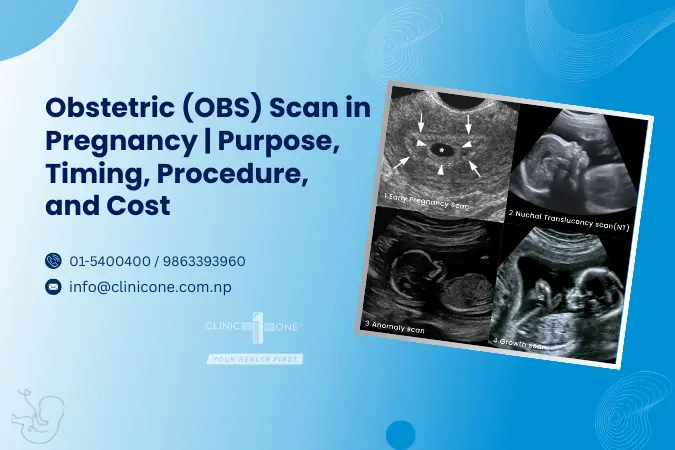
Pregnancy ultrasound follows four main stages: the early/dating scan, the nuchal translucency (NT) scan, the anatomy/anomaly scan (level II), and the growth scan. Each stage is performed at a specific time to assess fetal development and support timely medical decisions.

1. Early Pregnancy / Dating Scan
Usually performed between 6 and 11 weeks, an early pregnancy or dating scan is the first ultrasound performed in pregnancy. It confirms if the pregnancy is inside the uterus and detects the fetal heartbeat. The scan also determines whether there is a single baby or multiple fetuses.
One of its most important roles is calculating the Estimated Due Date (EDD) by measuring the embryo. Accurate dating at this stage helps guide the rest of the pregnancy timeline. In very early weeks, doctors may perform this scan transvaginally to obtain clearer images.
2. Nuchal Translucency (NT) Scan
The nuchal translucency (NT) scan is performed toward the end of the first trimester, usually between 11 and 14 weeks. It measures the nuchal translucency (fluid behind the neck). Increased thickness may indicate a higher risk of certain chromosomal conditions (Down syndrome, Trisomy 18, and other genetic conditions).
Doctors often combine this scan with maternal blood tests for more accurate screening results. While it does not provide a final diagnosis, it helps identify pregnancies that may need further evaluation.
3. Anatomy / Anomaly (Level II) Scan
An anatomy or level II scan is performed between 18 and 22 weeks (mostly in 20 weeks). Often referred to as the detailed or anomaly scan, this is one of the most comprehensive ultrasounds in pregnancy.
The sonographer performs a systematic head-to-toe evaluation of the baby’s organs and structures.
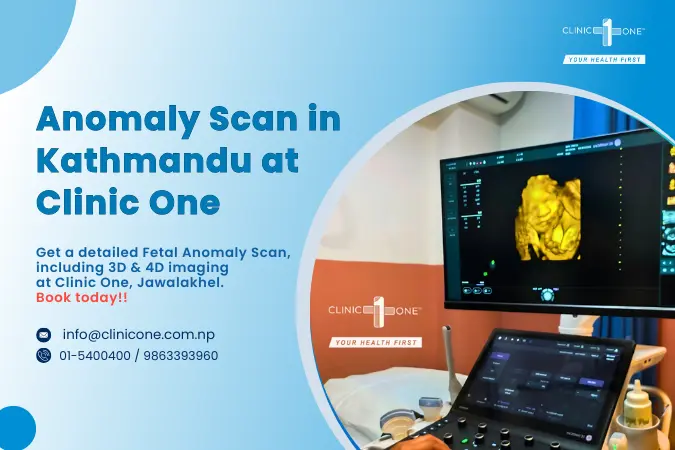
The scan assesses the brain, spine, heart, kidneys, limbs, and abdominal organs. It also evaluates the placenta and amniotic fluid levels. Also, this is the best time for a 3D/4D anomaly scan, and in many cases, parents may also learn the baby’s biological sex at this stage.
Caution: In some countries, like Nepal, confirming gender before birth is illegal. Hence, you must verify local laws and regulations before pursuing any prenatal testing or gender-related services.
4. Growth / Wellbeing Scan
The growth scan is typically performed in the third trimester between 24 and 42 weeks. It measures fetal size, estimates weight, and evaluates amniotic fluid levels. Doctors also assess the baby’s position, especially as delivery approaches.
If necessary, Doppler studies may be added during this stage to assess blood flow in the umbilical cord or placenta. This scan helps ensure the baby continues to develop appropriately in the final weeks of pregnancy.
How These Ultrasound Stages Work Together?
Pregnancy ultrasounds create a clear roadmap of your baby’s growth, guiding care at every stage. In the first trimester, early scans confirm the pregnancy, detect the heartbeat, and establish the due date.
By the second trimester, detailed anatomy scans examine the baby’s organs, limbs, and spine, allowing doctors to evaluate development and plan any necessary follow-ups. Later scans focus on growth, blood flow, and the baby’s position, helping doctors make informed decisions as delivery approaches.
Taken together, these scans form a connected sequence, where each visit builds on the last. Parents receive regular updates on the baby’s development, and doctors can respond to any unusual findings. This structured approach ensures that care is continuous, thorough, and appropriate for both mother and baby.
Advanced Imaging Used Across Different Pregnancy Stages
Doctors use specialised imaging technologies alongside standard ultrasound scans in pregnancy to get a more detailed view of fetal development and detect issues that may not be visible on routine scans. These might include:
- 3D/4D Ultrasound
- Doppler Ultrasound
- Fetal Echocardiogram
3D Ultrasound: Creates static three-dimensional images of the baby, giving clear views of facial features and structural details. Doctors use this to closely examine suspected anomalies like a cleft lip or limb differences.
4D Ultrasound: Adds real-time motion to 3D images, allowing observation of fetal movements, expressions, and behaviours. It is particularly useful for evaluating structural abnormalities and confirming findings from earlier scans.
Doppler Ultrasound: Measures blood flow in the umbilical cord, placenta, and fetal heart. Doctors rely on it when they need to monitor growth, assess circulation, or investigate maternal conditions such as high blood pressure or gestational diabetes.
Fetal Echocardiogram: Provides a highly detailed view of the baby’s heart. Doctors perform this scan when there’s a suspected cardiac issue, allowing precise assessment of heart chambers, valves, and major vessels.
Important Tip: In high-risk pregnancies, such as twins, gestational diabetes, hypertension, or previous complications, doctors might schedule additional growth scans or targeted Doppler and fetal echocardiograms. This proactive approach allows doctors to monitor the baby closely and address concerns as they arise.
How Ultrasound Scans Are Performed During Pregnancy?
Ultrasound scans in pregnancy follow a clear, step-by-step process to capture detailed images of your baby safely:
- Positioning: You lie on an examination table, usually on your back. The specialist may ask you to adjust your clothing or wear a gown so the lower abdomen is accessible.
- Gel Application: A clear, water-based conductive gel is applied to your skin. This eliminates air pockets and allows sound waves to pass efficiently, producing clear images of the baby.
- Using the Transducer: The specialist presses a handheld device called a transducer against your abdomen. You’ll feel it move, tilt, and rotate as it sweeps high-frequency sound waves across the uterus, capturing different views of the baby.
- Real-Time Imaging: Sound waves bounce off the baby’s tissues, and the transducer captures the echoes. These echoes are translated into a live, moving image on a monitor, allowing both doctor and parent to see the baby in real time.
- Measurement and Capture: The specialist “freezes” images to take precise measurements of the baby’s head, limbs, heart rate, and other key structures. On-screen markers help ensure accurate assessments.
- Cleanup: Once the scan is complete, the transducer is removed, and the remaining gel is wiped away. The entire procedure usually takes 20-30 minutes, depending on fetal position and the level of detail needed.
Note: If your pregnancy is very early (before 11 weeks) or the cervix needs closer evaluation, a Transvaginal Ultrasound (TVS) may be performed. In this case, a thin, lubricated probe is inserted into the vagina. Being closer to the uterus, it provides higher-resolution images when the baby is too small to be clearly seen through the abdominal wall.
Choosing the Right Pregnancy Ultrasound Clinic
When selecting an ultrasound clinic, you should focus on factors that ensure accurate scans and a smooth experience. Key aspects to look for include:
- Experienced Radiologists & Sonographers
- Accurate Scheduling & Minimal Wait Times
- Structured Reporting and Explanation
- Follow-Up Support and Guidance
- Private and Comfortable Environment
- Convenient Location and Accessibility
For families in Kathmandu, Clinic One offers comprehensive ultrasound services, including routine scans, advanced imaging, and additional monitoring for high-risk pregnancies. Our team combines medical expertise, modern technology, and professional support to provide reliable prenatal evaluations.
Book a Pregnancy Ultrasound with Trusted Experts at Clinic One
Conclusion
Ultrasound scans in pregnancy follow a structured timeline, providing detailed insights at each stage. From early scans that confirm the pregnancy to later scans that monitor growth, anatomy, and position, each stage contributes to comprehensive prenatal care. By understanding the different stages, specialised imaging, and procedure types, parents can stay informed and prepared.
For families in Kathmandu, Clinic One offers a full range of ultrasound services, from routine scans to advanced imaging and additional monitoring for high-risk pregnancies. With experienced specialists, modern equipment, clear explanation and detailed reporting, we provide reliable support and guidance throughout pregnancy.
Frequently Asked Questions
How many ultrasounds in pregnancy are safe?
Ultrasounds are safe when performed by trained professionals. For most normal pregnancies, 2 to 5 scans are sufficient to monitor the baby’s development. But high-risk pregnancies may require additional scans to track growth or specific conditions.
Can a 6-week ultrasound detect twins?
Yes. A 6-week ultrasound can detect twins by identifying multiple gestational sacs, yolk sacs, or heartbeats in the uterus. A transvaginal scan is usually most effective at this stage, though sometimes one twin may be hidden, making follow-up scans necessary.
How to do the first ultrasound in pregnancy?
The first ultrasound is usually a transvaginal scan if performed before 8-9 weeks to obtain clear images of the embryo. A transabdominal scan may be done from around 7 weeks, but is more common after 10 weeks.
In both cases, the radiologist or sonographer applies gel and uses a probe: either moved over the abdomen or inserted briefly into the vagina, to capture real-time images of the pregnancy.
What type of ultrasound is done at 4 weeks?
At 4 weeks, the pregnancy is often too early to visualise the embryo clearly. If an ultrasound is performed at this stage, it is almost exclusively a transvaginal scan because it provides better early detail. This is why many doctors prefer to wait until 6 or 7 weeks, unless there is a specific medical concern.