
Corn vs Callus: Easy Ways to Differentiate Them
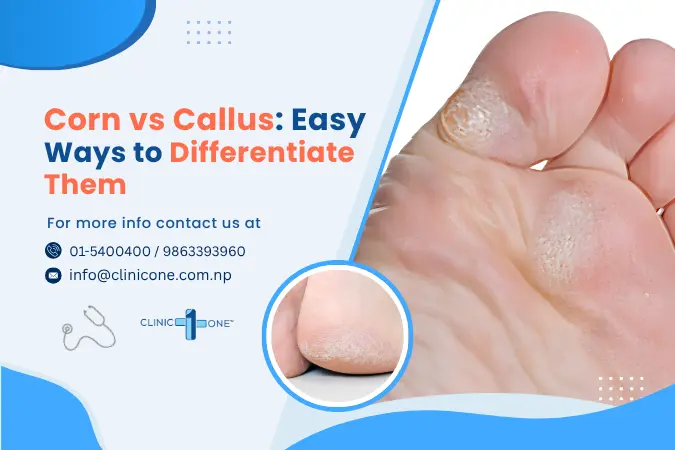
If you’re wondering how to know if it’s a callus or a corn, the answer comes down to pain, appearance, and location. Both are types of thickened skin caused by repeated friction or pressure, but they behave differently.
A corn is usually small, round, and painful with a hard centre, often forming on or between toes. Callus, on the other hand, is larger, flatter, and usually painless, commonly appearing on the soles of your feet. Still confused? Don’t worry, we’ll break down their key differences in the next sections so you can easily tell them apart.
Need Expert Help?
Visit us for precise diagnosis and safe treatment of corns and calluses
Key Differences Between a Callus and a Corn
The fastest way to tell the difference between a corn and a callus is:
- A corn is small, deep, and often painful, especially when you press directly on it
- A callus is larger, more spread out, and usually not painful
- A corn has a hard central core (“eye”), while a callus does not
- A corn typically forms on toes or bony areas, whereas a callus appears on weight-bearing areas like the sole
In short:
- Pain + core = likely a corn
- Thick, rough skin without pain = likely a callus
Below is a simpler table to differentiate between them.
| Feature | Corn | Callus |
|---|---|---|
| Size | Small and well-defined | Larger and more spread out |
| Shape | Round with a central core | Flat and thickened area |
| Pain | Often painful | Usually painless |
| Location | Toes, pressure points | Soles, heels, palms |
| Texture | Hard centre with surrounding skin | Rough, thick, and uniform |
| Depth | Deep (core present) | Superficial |
| Cause | Localised pressure or friction | Repeated friction over an area |
| Sensitivity | Tender to touch | Less sensitive |
Other 3 Ways to Differentiate Corn and Calluses
If you’re still unsure after looking at the appearance, don’t worry. There are a few simple at-home checks that can help you distinguish a corn from a callus more confidently. These are:
- Press and Poke Test
- Look for the “Eye”
- Check the Location
The “Press and Poke” Test
One of the easiest ways to tell the difference is by checking how the area responds to pressure.
- Corn: Hurts sharply when you press directly on it from above
- Callus: Usually feels thick but does not cause sharp pain
Why does this happen? A corn has a hard central core that presses into deeper skin layers, making it more sensitive than a callus.
Look for the “Eye”
Another key difference is the presence of a central core.
- Corn: Has a visible hard centre (also called an “eye”)
- Callus: Has no defined centre, just a uniform thick layer of skin
Tip: If you see a small, concentrated hard spot in the middle, it strongly suggests a corn.
Check the Location
Where the thickened skin appears can also give you a big clue.
- Corn: Usually found on toes, between toes, or bony pressure points
- Callus: Commonly appears on heels, soles, or palms, where pressure is spread out
What Causes Corns and Callus Formation?
Both corns and calluses form as your skin’s natural defence response to repeated pressure or friction. In simple terms, your body is trying to protect deeper tissues by building up thicker layers of skin. However, the pattern of pressure determines whether you develop a corn vs callus.
Let’s break it down clearly.
Ill-Fitting or Tight Footwear
One of the most common causes for their formation is wearing shoes that don’t fit properly. Poor footwear creates repeated friction, forcing skin to thicken for protection.
- Tight shoes compress toes → lead to corns
- Loose shoes cause rubbing and sliding → leads to calluses
- High heels increase pressure on specific toe points → corn formation
Repetitive Pressure or Friction
Your daily activities also play a major role. When friction occurs at a single point, a corn develops, whereas when friction spreads over a large area, a callus forms.
- Long walking or standing hours
- Running or sports activities
- Using tools or manual labour (for hands)
- Uneven pressure while walking
Foot Deformities or Biomechanical Issues
Structural problems in the feet can increase pressure on certain areas. These conditions shift weight unevenly, causing repeated stress and skin thickening.
- Bunions
- Hammertoes
- Flat feet or high arches
- Abnormal gait (walking pattern)
Walking Barefoot Frequently
Regular barefoot walking on hard surfaces can also contribute to the formation of corn and callus. It is due to increased direct pressure on the soles.
If this continues, it:
- Leads to protective thickening of skin (callus formation)
- Or can also create pressure points that develop into corns
Lack of Protective Cushioning
Natural fat padding under the feet can reduce with age or stress. Natural fat under our feet acts as natural cushioning, and when its presence decreases, it leads to more bone-to-surface pressure. Thus, Skin responds by becoming thicker and tougher. This is especially common in older adults.
High Activity Lifestyle or Occupation
Some lifestyles and jobs naturally put more pressure on the feet or hands, which increases the risk of developing corns and calluses. These include athletes who run, jump, or train frequently, construction or labour workers who spend long hours on their feet, people who stand for extended periods, such as teachers or retail workers, and musicians or manual workers who repeatedly use their hands
When It Might Be Something Else
Not every thick, hard patch of skin on your feet is a corn or callus. While they are the most common causes, a few other skin conditions can look very similar, especially in the early stages. So, identifying these correctly is important because their treatment is completely different.
Here are the main conditions that are often mistaken for corn and callus.
- Plantar Warts: These are caused by a virus. They often look like hard skin on the foot, but may have tiny black dots in the centre. They are usually painful when you squeeze them from the sides, not just when you press down.
- Blisters: Blisters form due to sudden friction or burns, not long-term pressure. It contains a fluid-filled bubble under the skin, which can burst and become sore.
- Foreign Body in Skin: Sometimes, a tiny piece of glass, wood, or metal gets stuck in the skin. Over time, the skin becomes hard around it, making it look like a corn or callus, but the real cause is the trapped object.
- Foot Ulcers: These are open wounds, often seen in people with diabetes. They may be surrounded by hard skin and can get infected if not treated properly.
- Plantar Fibroma: This is a firm lump in the arch of the foot. It feels more like a small knot under the skin rather than a flat, hard patch.
- Rough Skin Condition: Some people naturally develop small rough bumps on the skin that are not caused by pressure. These can sometimes feel similar to calluses.
- Bunion: This is a bony bump near the big toe. Because shoes rub against it, a hard layer of skin can form over it, making it look like a callus.
- Skin Cancer (Rare Cases): Though these are very rare. But sometimes skin cancers, like Melanoma or Carcinoma, can mimic the appearance of corn and callus. In such cases, it may look like a long-lasting hard spot that doesn’t heal or keeps changing.
When Should You See a Doctor?
Most corns and calluses are harmless, but sometimes they can become painful, persistent, or confused with other conditions. In those cases, self-care may not be enough, and getting professional help is the best option.
You should consider seeing a doctor if:
- The pain is getting worse or interfering with walking
- Thickened skin does not improve even after home care
- The problem area becomes red, swollen, or starts leaking fluid
- You have diabetes or poor blood circulation
- The spot keeps coming back to the same place
- You are unsure whether it is really a corn vs callus or something else
Important Consideration: In people with diabetes, even small foot problems should never be ignored because healing is slower and the risk of infection is higher.
Treatment Options
Treating a corn or callus depends on how painful it is, how long it has been there, and whether it keeps coming back. In many cases, simple home care helps, but persistent or painful cases may need medical treatment.
Home Care Treatment(First-Line Treatment)
For mild corns and calluses, you can start with basic care at home:
- Soak your feet in warm water for 10-15 minutes to soften the skin
- Gently use a pumice stone or foot file to reduce thickened skin (do this slowly, don’t overdo it)
- Apply a moisturising cream daily to keep skin soft
- Wear comfortable, well-fitted shoes to reduce pressure
- Use soft padding or cushions over painful areas
Important Note: Never try to cut or shave the corn yourself, as it can lead to infection or injury.
Medical Treatments
If home care is not enough, medical treatments can help safely remove or reduce the problem. This treatment is especially helpful for painful, recurring, or deep corns.
- Professional trimming: A doctor safely removes thickened skin using sterile tools
- Medicated patches or creams: Help soften and gradually reduce the hard skin
- Pressure relief techniques: Special pads or orthotic inserts to reduce friction
- Treatment of underlying cause: Correcting walking pattern or footwear issues
Corn and Callus Treatment at Clinic One
At Clinic One, treatment focuses on both removal and prevention of recurrence. Our care process includes:
- Identifying whether the problem is a corn, callus, or another condition
- Safely removing thickened skin using clinical methods
- Finding the exact pressure points causing the issue
- Guiding patients on proper footwear and foot care habits
- Creating a prevention plan to reduce future recurrence
Book Your Corn Removal Treatment at Clinic One
Final Thoughts
The difference between a corn and a callus is simple: corns are small, painful spots caused by point pressure, while calluses are larger, painless areas caused by spread-out friction. If you remember this basic pattern, you can identify most cases without confusion. However, if the area looks unusual, keeps changing, or doesn’t improve with time, seek proper medical evaluation.
At Clinic One, we help patients accurately identify the exact cause and provide safe, effective treatment. Care typically includes professional removal of thickened skin, relieving pressure points, and guiding you on proper footwear and foot care to prevent recurrence. Book Appointment Today!!
Frequently Asked Questions
What is the best treatment for corn removal?
The best treatment includes safely removing the thickened skin, relieving pressure on the affected area, and correcting the cause, such as footwear issues or walking patterns.
Is it okay to dig a corn out?
No, it is not safe to dig or cut out a corn at home. Doing so can lead to pain, bleeding, or infection. Corns have a hard core, and removing them incorrectly can make the problem worse. It is always better to use safe home care or get it treated by a professional.
What does a callus or corn look like?
A corn usually looks like a small, round, hard spot with a central core and may be painful when pressed. A callus looks like a larger, flat, and rough patch of thickened skin that is usually not painful. Corns are more localised, while calluses are more spread out.
Can you get rid of a corn or callus?
Yes, both can be reduced or removed with proper care. Mild cases often improve with better footwear, skin care, and pressure reduction. Persistent or painful cases may need professional treatment to safely remove thick skin and prevent it from coming back.

![Best Cardioloigist in Kathmandu, Nepal | Dr. Dipak Raj Baral [NMC No. 5626]](https://clinicone.com.np/wp-content/uploads/2026/09/Best-cardiologist-in-kathmandu-Nepal.webp "Best Cardioloigist in Kathmandu, Nepal | Dr. Dipak Raj Baral [NMC No. 5626]")