
Japanese Encephalitis Cases in Nepal
Japanese Encephalitis Cases in Nepal: Latest 2026 Update
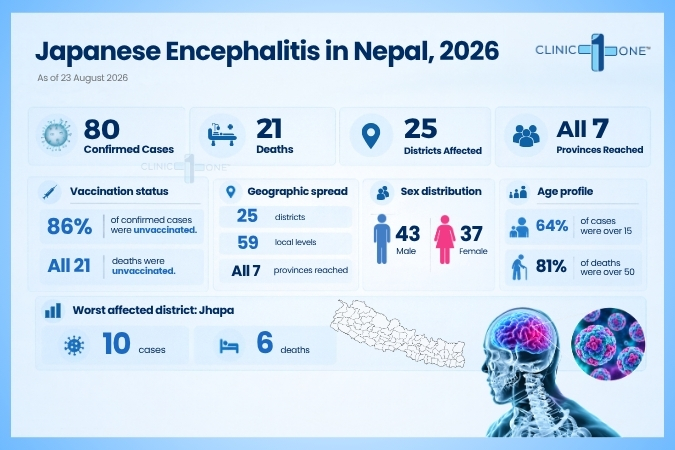
Japanese encephalitis (JE) is a mosquito-borne viral disease that inflames the brain, and it is spreading across Nepal during the 2026 monsoon. According to the Family Welfare Division under the Department of Health Services, around 80 laboratory-confirmed cases had been reported across 25 districts by 23 August 2026, and 21 people had died. The outbreak has reached all seven provinces. The worst-hit district is Jhapa, where six of the 10 infected people died, a 60 % death rate that is the highest in the country and the reason officials are planning an emergency adult vaccination drive there. Cases cluster in the Terai and inner Madhesh plains, though the virus has now reached the hills too.
These figures count only laboratory-confirmed cases. Patients who arrive with sudden fever and brain symptoms are first recorded under the broader label of Acute Encephalitis Syndrome (AES), and only a laboratory test confirms which ones are JE.
According to the Family Welfare Division, 86 % of the confirmed patients were unvaccinated, and all 21 who died were unvaccinated.
Last updated: 23 August 2026. These figures are provisional and may rise as more suspected cases are tested.
Where Are JE Cases Being Reported in Nepal?
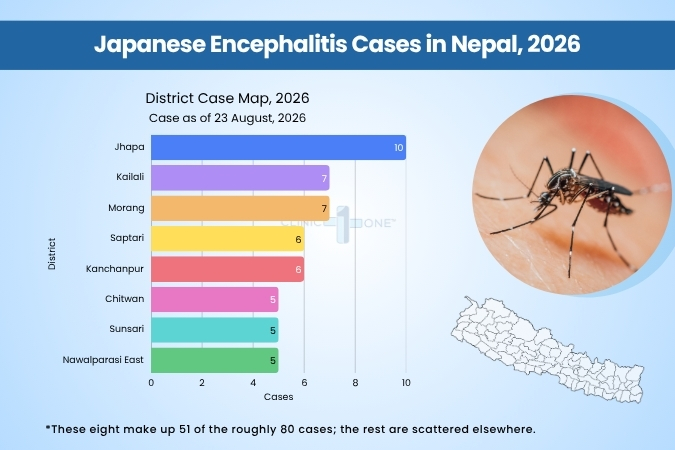
The outbreak is not spread evenly. By 23 August 2026, cases had reached 25 districts, but a few districts had most of the cases. The districts with the most confirmed cases are shown below.
| District | Confirmed Cases |
|---|---|
| Jhapa | 10 |
| Kailali | 7 |
| Morang | 7 |
| Saptari | 6 |
| Kanchanpur | 6 |
| Chitwan | 5 |
| Sunsari | 5 |
| Nawalparasi East | 5 |
These eight districts make up 51 of the roughly 80 cases. The rest are spread across other districts in smaller numbers. Most of these districts are in the Terai, the flat belt along Nepal’s southern border. Rice fields and pig farming are common there, and both help the mosquitoes that spread the virus.
Deaths are concentrated in a similar group of districts. The figures below, reported by the Kathmandu Post, show the districts with the most deaths.
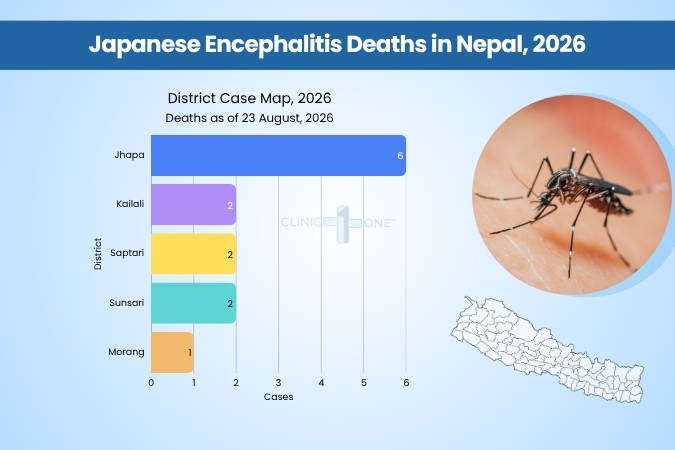
| Districts | Deaths |
|---|---|
| Jhapa | 6 |
| Kailali | 2 |
| Saptari | 2 |
| Sunsari | 2 |
| Morang | 1 |
These five districts account for 13 of the 21 deaths. Jhapa is the clear centre of the outbreak. Six deaths from only 10 cases is the highest death rate in the country, and this is why officials are starting the adult vaccination drive in Jhapa and Kailali.
The disease has also spread beyond the plains. Cases have been confirmed in hill districts too, including Ilam, Kavrepalanchok, Kathmandu, Sindhuli and Surkhet. This is one of the more worrying parts of this year’s outbreak.
There is one point to keep in mind. These figures show only laboratory-confirmed cases up to the reporting date. A district with few or no recorded cases has not necessarily escaped the virus. It may simply be testing fewer people. So the figures show where cases were confirmed, not where the disease actually is.
How Have JE Cases Changed in Nepal?
![Japanese Encephalitis: Historical Trend [2004 - 2025]](https://clinicone.com.np/wp-content/uploads/2026/10/4.webp "Japanese Encephalitis: Historical Trend [2004 - 2025]")
JE has been in Nepal for decades, and the longer record explains why this year worries officials. According to the Annual Health Report, confirmed cases were high in the mid-2000s and peaked at 584 in 2005, before the vaccine was widely used. The vaccine then reached one district after another, and cases fell steadily through the 2010s. By 2020 they had dropped to 29, the lowest on record. This was one of Nepal’s clearest public-health wins.
The trend has since reversed. Cases rose again to 107 in 2023 and reached 183 in 2025, the highest in over a decade. The disease is now back at levels last seen before the vaccine brought it down.
Deaths have risen too. They stayed low through the 2010s, then climbed to 23 in 2024 and 30 in 2025. This year’s outbreak has already killed 21 people by late August, and the monsoon is not over.
One year alone does not make a trend, because cases go up and down with rainfall, mosquito numbers and how many people are tested. The pattern over several years matters more. Cases climbed steadily from 2020 to 2025, and 2026 is severe. That points to a real return of the disease, not a one-off spike, and it is why calls for wider vaccination have grown.
Who Is Being Affected by JE?
JE was mainly a childhood disease in Nepal for most of its history. A government surveillance analysis of cases from 2004 to 2024 found that almost 60 percent were children under 15, since young children had not yet built up immunity. This year’s outbreak reverses that pattern.
Most patients are now adults. Of the roughly 80 confirmed cases as of 23 August 2026, 51, or 64 percent, were over 15, according to the Family Welfare Division. Among those who died, more than 80 percent were over 50, and every death was unvaccinated.
Cases are split fairly evenly between men and women: 43 male and 37 female. This suggests exposure to the mosquitoes is broadly shared rather than tied to one sex.
Vaccination status is the clearest divide. 86 percent of confirmed cases had not received the vaccine, and none of those who died had. This year’s outbreak is falling hardest on unvaccinated adults, especially older ones. Why this shift is happening, and what it means for vaccination policy, comes later in this article.
What Does Five Years of Clinic One Vaccination Activity Show?
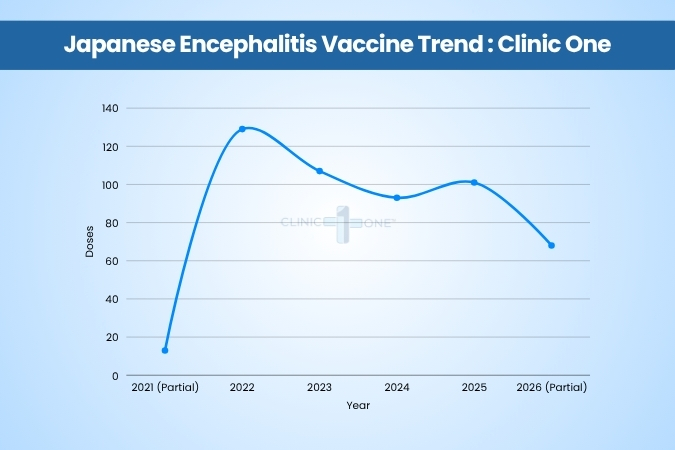
The sections above use national figures. This one turns to Clinic One’s own records, a separate, ground-level view. These are not disease figures. They show only how many people came to Clinic One for the JE vaccine, and when.
Between October 2021 and September 2026, Clinic One gave around 511 JE vaccine doses. Full-year totals ran at about 129 doses in 2022, 107 in 2023, 93 in 2024 and 101 in 2025, with 2021 and 2026 covering only part of a year. Volume has held in a fairly steady range from year to year, rather than rising or falling sharply.
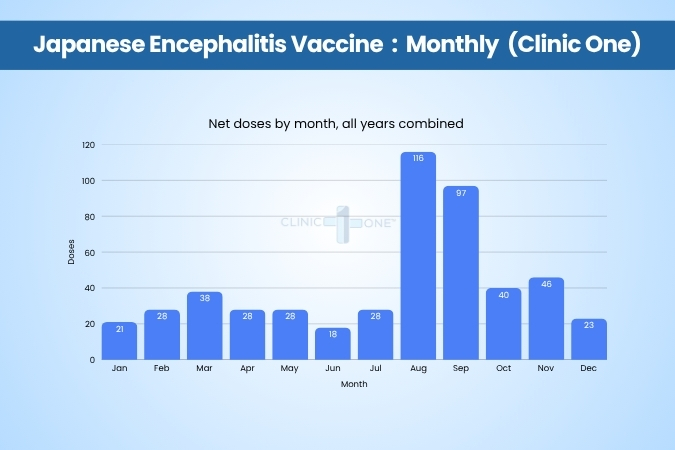
Three patterns stand out from the records. The first is seasonal. Demand concentrates in August and September, which together make up 213 of the 511 doses, more than 40 percent of the total in just two months. This is the same stretch each year when the monsoon drives mosquito activity and JE is in the news.
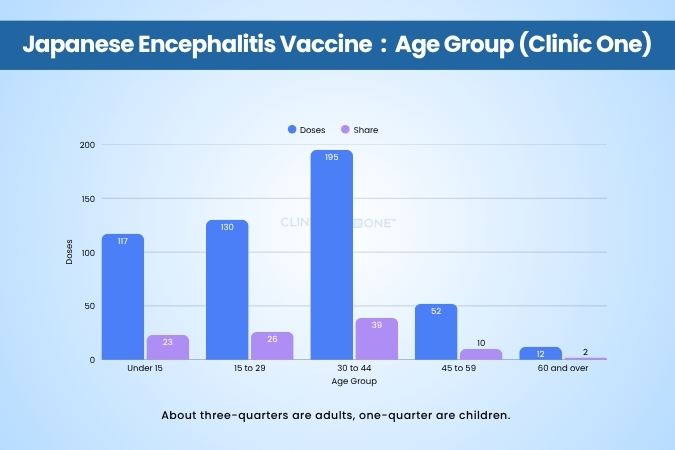
The second is age. A little over three-quarters of doses went to adults, and just under a quarter went to children under 15. The largest single group was adults aged 30 to 44, and this age mix stayed steady across the five years. The adult share makes sense, since Nepal’s free government vaccine goes only to children, so adults seeking protection usually pay for it privately. The quarter going to children shows the clinic is also reaching some who missed the government schedule.
The third pattern is that volume itself held steady rather than climbing, even as national cases rose over the same years. This becomes useful later, when we look at how demand shifted during the 2026 outbreak.
Did the 2026 Outbreak Change Vaccination Activity?
The 2026 outbreak lets us check whether public attention to JE lined up with demand for the vaccine at Clinic One. These records cannot show why any one person chose to get vaccinated. Any link here is about timing, not proven cause.
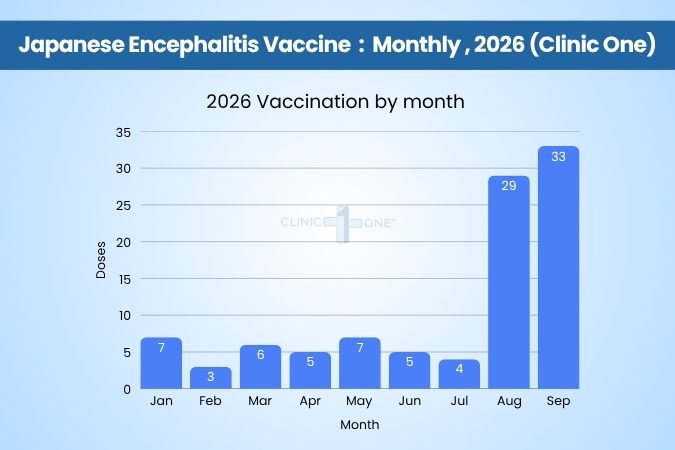
The first seven months of 2026 were quiet, averaging about five doses a month. In August, doses jumped to 29, about six times that average. Much of the rise came on one day, 9 August, when 13 people were vaccinated. That same day, the outbreak reached national news, with reports of nine deaths, dozens of infections, and warnings that the peak season was coming. Vaccination demand and public attention rose together.
The age of people getting vaccinated barely changed. About one in five were under 15 both before and during August, so it was largely the same mix of people coming forward in greater numbers, not a different group.
The rest of August stayed busier than the quiet months before it, even as coverage moved to higher case and death counts. This fits general health research, which finds people are more likely to seek vaccination when a disease is visible in the news.
Two things are worth keeping in mind. Demand for the JE vaccine rises every August and September regardless of any outbreak, because that is monsoon season, so part of the 2026 rise is simply seasonal. And August 2026, while far above the previous three years, was not the highest on record, since August 2022 saw more. Vaccination rose along with the outbreak. But demand also rises every monsoon on its own, so the records cannot separate the two. It looks like people came because the danger felt real that year, not just because it was the season again.
![Japanese Encephalitis: District Deaths Nepal [2025]](https://clinicone.com.np/wp-content/uploads/2026/10/6.webp "Japanese Encephalitis: District Deaths Nepal [2025]")
JE Cases and Vaccination Trends: What Can We Learn?
This section puts two things side by side. One is the national pattern of the disease. The other is the pattern of vaccination at Clinic One. They come from different sources and measure different things, so one cannot explain the other. What they share is timing.
Both rise in the monsoon. JE spreads when mosquitoes bite infected pigs or water birds and then bite humans, passing the virus on. According to the World Health Organization, these mosquitoes breed in flooded rice fields, which flood during the monsoon, so infections peak from around August to October. Clinic One’s records follow the same calendar. August and September alone make up more than 40 percent of all doses given over five years, and August to October makes up about half.
The months when the disease is most active are also the months when most people get vaccinated. This is expected, since both follow the same season, and people tend to seek the vaccine when the disease is in the news.
What these numbers cannot show matters just as much. The two datasets differ too much in size and kind for the vaccination figures to tell us how many infections were prevented, or how well the wider population is protected. They only show that vaccine demand follows the same seasonal calendar as the disease.
![Deaths Caused by JE [2024 - 2026]](https://clinicone.com.np/wp-content/uploads/2026/10/5.webp "Deaths Caused by JE [2024 - 2026]")
Why Are JE Cases Still Occurring Despite Vaccination Availability?
Nepal has a safe, effective JE vaccine, and it has used it well. So why are people still falling ill and dying? It comes down to who the vaccine has reached, and who it has not.
The vaccine rolled out in stages. According to the AES/JE Surveillance Manual, Nepal began JE campaigns in 2006, finished all 31 high-risk districts by 2011, and covered the rest of the country by 2016. The vaccine sits in the routine childhood schedule, given at 12 months, with a catch-up dose allowed up to age five.
The programme worked. A 2017 study by Upreti and colleagues found that after the campaigns, JE cases were 78 percent lower than expected without vaccination, and estimated around 3,011 cases were prevented across the 31 districts. This is the main reason confirmed cases fell so sharply through the 2010s.
But the same schedule left a gap. Since the vaccine goes only to young children, anyone already past that age when the campaign reached their district never got it. A 2026 study on Nepal’s adult immunity gap makes this point directly: protection stayed concentrated in vaccinated districts and eligible age groups, not spread across the adult population. These are the adults the current outbreak is striking, since 64 % of this year’s cases are over 15, and every death was unvaccinated. Age worsens the outcome too, as more than 80 % of this year’s deaths were people over 50.
Two other factors keep cases going. First, vaccinating adults is not simple. A 2026 review of vaccination behaviour found that cost, limited availability, and low awareness all hold people back, especially among those with less schooling. Second, the disease is hard to avoid in the Terai. JE spreads when mosquitoes bite infected pigs or water birds and then bite humans. These mosquitoes breed in flooded rice fields, and the Terai’s warm, wet plains, with their paddy fields and pig farming, suit this cycle well. This is why the Terai has always carried most of Nepal’s JE, while the hills saw far less.
How JE is counted also shapes what we see. According to the Surveillance Manual, only about 1 in 250 infections leads to severe disease, so confirmed cases are just the visible tip of a much larger number of quiet infections. The pattern is also changing. The disease is moving from children into unvaccinated adults, and this year it reached hill districts once considered low-risk. As the manual notes, when JE enters an area for the first time, people of all ages can fall ill, since none of them have built-up immunity.
The vaccine protects the children it reaches, and it has prevented thousands of cases. But a large group of adults was never covered, and that is the group the disease is now finding.
Is JE Becoming an Adult Health Concern in Nepal?
For most of its history in Nepal, JE was treated as a childhood illness, and the vaccination programme was built around protecting children. This year’s outbreak has forced a rethink, since most of the people falling seriously ill are now adults.
The national figures make this plain. According to the Family Welfare Division, 64 % of this year’s confirmed cases were over 15, and among the deaths, more than 80 % were over 50. The vaccination pattern is just as clear: every person who died this year was unvaccinated, and 86 % of all confirmed cases had not received the vaccine. Most of these are adults who were already too old for the vaccine when it reached their district, and who have had no protection since.
Official thinking is starting to shift. In September 2026, the Ministry of Health announced its first JE vaccination campaign aimed at adults, a direct response to the rising toll. The campaign targets people aged 30 and above, and begins 1 October in parts of Kailali and 5 October in Jhapa, the two hardest-hit districts. This is a real departure, since the government vaccine had gone only to children for nearly two decades. Officials have framed it as a first phase, so wider adult vaccination may follow if the need and funding allow.
One point matters here. Adults seeking the vaccine, and now being offered it in these two districts, does not tell us how protected the wider adult population is. Clinic One’s own records, discussed earlier, show adults coming forward for vaccination, but those are the choices of people at one clinic and cannot stand in for the country’s adults as a whole. What the national data does show is a real and rising concern: JE in Nepal is no longer mainly a disease of children, and unvaccinated adults are now the group most at risk.
How Can People Reduce Their JE Risk?
There is no cure for JE. According to the CDC, treatment can only manage symptoms, which is why protecting yourself beforehand matters. There are two main ways to do this: vaccination and avoiding mosquito bites.
Vaccination is the most effective protection. Children in Nepal get the JE vaccine free through the national immunisation programme, and adults who were never covered can get it at private clinics. In the hardest-hit districts, the government has now begun offering it to adults too.
The mosquitoes that carry JE bite mainly from dusk to dawn, so avoiding bites during those hours matters most. The CDC and WHO advise using a mosquito repellent, such as those containing DEET, on exposed skin, wearing long sleeves and trousers, and sleeping under a mosquito net, especially near rice fields and livestock. Screens on windows and doors, and clearing standing water where mosquitoes breed, add further protection.
Finally, know when to act. Most infections cause no symptoms, but according to the CDC, severe illness begins with sudden fever, headache and vomiting, and can progress within days to confusion, neck stiffness, seizures or weakness. Anyone with a high fever and these brain-related symptoms should get medical care immediately, since early treatment gives the best chance of recovery.
What the Numbers Do Not Tell Us
These figures have real limits. National case figures do not capture every infection. Most JE infections cause no symptoms, so they are never tested or recorded. Confirmed cases are only those sick enough to reach a hospital and get tested. The true number of infections is higher than any official count.
Clinic One’s records carry different limits. They show how many people came to one clinic to get vaccinated, nothing more. They are not a measure of vaccination coverage across Nepal, or even across the Kathmandu Valley. National coverage is a separate thing these records cannot show.
Vaccination demand is also not the same as disease spread. When more people came for the vaccine in August, that reflected concern and awareness, not the number of infections in that area.
The records cannot explain why any single person chose to be vaccinated. Visits rose when the outbreak was in the news, but the data does not record anyone’s reasons. We can describe the timing, not the motive.
None of this data can show that the vaccine prevented any particular infection, or count how many cases were avoided. Clinic One’s figures show vaccination activity, not outcomes.
What the numbers do show is that the disease is rising, that it is reaching unvaccinated adults, and that people are seeking protection when the risk feels close. What they cannot answer stays unanswered.
Sources & Data Updates
The figures in this article come from official, academic and news sources, each used for what it suits best.
National case and death figures come from Nepal’s government health bodies, chiefly the Family Welfare Division under the Department of Health Services. Historical figures come from the government’s Annual Health Report 2081/82 (2024/25), published June 2026, and the AES/JE Surveillance Manual (Family Welfare Division, 2025).
Medical and epidemiological context comes from the World Health Organization’s fact sheet on JE (updated August 2024) and from peer-reviewed research: Upreti and colleagues’ 2017 study in PLOS Neglected Tropical Diseases on the impact of Nepal’s vaccination programme, a 2026 study on the country’s adult immunity gap, and a 2026 review of vaccination behaviour published in Vaccine. Prevention and symptom guidance follow the WHO and the US Centers for Disease Control and Prevention.
Current outbreak figures for 2026 come from Nepali news outlets, chiefly the Kathmandu Post and Nepal News, which carry the Family Welfare Division’s regular updates through August and September 2026. These figures are provisional, since they are released during an active outbreak and change as more cases are confirmed.
Clinic One’s figures come from the clinic’s own aggregated JE vaccination records, covering October 2021 to September 2026, reviewed for trend analysis and public awareness. They are shown only in aggregate and kept separate from national disease data throughout. Doses are counted rather than individual clients, since the records cannot always tell one person from another. Ages are worked out from each client’s date of birth and the date of vaccination; some birth dates were recorded only approximately, so ages are shown as broad groups rather than exact figures.
A note on the data: official sources sometimes give slightly different figures for the same year, which is normal for surveillance data that gets revised over time. Where this happens, we used the most recent official report and noted the discrepancy. National outbreak figures reflect the latest reporting available at the time of writing.
Published: [date]. Last updated: [date].
References
Government and public-health sources
Family Welfare Division, Department of Health Services, Ministry of Health and Population, Government of Nepal, Annual Health Report 2081/82 (2024/25), published June 2026. https://hmis.gov.np/media/74/eBook-Digital—Annual-Health-Report-2081-82.pdf
Family Welfare Division, AES/JE Surveillance Manual, 2025. https://fwd.gov.np/site_uploads/articles/aes-je-sur-448090119.pdf
International and peer-reviewed sources
World Health Organization, Japanese Encephalitis fact sheet (updated August 2024). https://www.who.int/news-room/fact-sheets/detail/japanese-encephalitis
Upreti SR, et al. (2017), Updated estimation of the impact of a Japanese encephalitis immunization program with live, attenuated SA 14-14-2 vaccine in Nepal. PLOS Neglected Tropical Diseases. https://journals.plos.org/plosntds/article?id=10.1371/journal.pntd.0005866
Japanese encephalitis in Nepal: closing the adult immunity gap (2026). Tropical Medicine and Health. https://link.springer.com/article/10.1186/s41182-026-01011-8
Nepali R, et al. (2026), Knowledge, attitudes and behaviour towards Japanese encephalitis vaccination: a systematic review. Vaccine. https://www.sciencedirect.com/science/article/pii/S0264410X2600808X
US Centers for Disease Control and Prevention, Japanese Encephalitis: About, Symptoms, and Prevention. https://www.cdc.gov/japanese-encephalitis/about/index.html
Current outbreak reporting (2026)
Kathmandu Post, JE outbreak coverage, August 2026. https://kathmandupost.com/health/2026/08/23/six-je-deaths-in-10-cases-put-jhapa-at-centre-of-vaccination-push
Nepal News, Family Welfare Division outbreak update, 23 August 2026. https://english.nepalnews.com/s/health/health-division-urges-precaution-as-unvaccinated-japanese-encephalitis-cases-and-deaths-rise/
Ratopati, Adult JE vaccination campaign in Jhapa and Kailali, 9 September 2026. https://english.ratopati.com/story/78493/vaccination-campaign-to-be-conducted-in-jhapa-and-kailali
Clinic data
Clinic One aggregated JE vaccination records, October 2021 to September 2026, reviewed for trend analysis and public awareness.