
Ideal Body Weight for Men According to Height
Introduction
A study from the NHANES showed that the prevalence of obesity among men was around 34.1%. This data shows the importance of knowing the ideal body weight, which is more than just a number on the scale. It is key to maintaining overall health, boosting energy, and feeling your best.
Hence, let’s explore what defines this “ideal” and how to measure it. You’ll also learn different ideal weight ranges based on height in kilograms (kg) and pounds (lb), and how to achieve them.
What Is Ideal Body Weight?
Your ideal body weight (IBW) is the weight at which your body functions best, reducing health risks such as diabetes, heart disease, joint problems, and others. It differs from a healthy weight range, which considers a broader range based on age, muscle mass, and overall body composition.
How to Calculate Your Ideal Body Weight?
You can calculate your ideal body weight using the Devine and the Hamwi formula. Among both, the most commonly used method is the Devine formula.
Devine Formula
-
- In kilograms (kg): 50+ 2.3 (height in inches – 60)
- In pounds (lb): 110+5 (height in inches – 60)
For example, if you are 5’10” (70 inches) tall:
-
-
- To calculate your ideal weight in KG: “50 + 2.3 (70-60) = 50 + 2.3 * 10 = 50 + 23 = 73 kg”
-
-
-
- To calculate your ideal weight in Lb: “110 + 5 (70-60) = 110 + 5 * 10 = 110 + 50 = 160Ib”
-
So, based on this formula, an ideal body weight for a 5’10” man is approximately 73kg or 160 lb.
Hamwi Formula
-
- In kilograms (kg): 48+ 2.7 (height in inches -60)
- In pounds (lb): 106+6 (height in inches – 60)
For example, if you are 5’8” (68 inches) tall:
-
-
- Calculate your ideal weight in KG like this, 48 + 2.7 (68 – 60) = 48 + 2.7 * 8 = 48 + 21.6 = 69.6 kg
-
-
-
- Calculate your ideal weight in Lb like this, 106 + 6 (68-60) = 106 + 6 * 8 = 106 + 48 = 154 Ib
-
Similarly, the ideal body weight for men using the Hamwi formula is approximately 69.6 kg or 154 lb.
NOTE: This is a rough estimation; other factors like muscle mass and body fat percentage matter too.
Ideal Body Weight Range for Men (in KG and LB)
The table below provides a reference for the ideal weight ranges for men based on height:
| Height in Feet and Inches | Height in Centimeter | Weight range (Devine Formula)
| Weight range (Hamwi Formula) |
||
|---|---|---|---|---|---|
| KG | Lb | KG | Lb | ||
| 5’0″ | 152 | 45.0-52.5 | 99-116 | 43.2-50.4 | 95-111 |
| 5’1″ | 155 | 47.1-54.9 | 104-121 | 45.6-53.2 | 100-117 |
| 5’2″ | 157 | 49.3-57.4 | 109-127 | 51.0-59.5 | 112-131 |
| 5’3″ | 160 | 51.5-59.9 | 113-132 | 53.5-62.3 | 118-137 |
| 5’4″ | 163 | 53.7-62.3 | 118-137 | 56.0-65.2 | 123-144 |
| 5’5″ | 165 | 55.4-64.6 | 122-142 | 57.5-66.9 | 127-147 |
| 5’6″ | 168 | 57.4-66.9 | 127-147 | 61.0-71.1 | 134-157 |
| 5’7″ | 170 | 59.5-69.4 | 131-153 | 64.1-74.7 | 141-165 |
| 5’8″ | 173 | 61.7-71.9 | 136-158 | 67.2-78.3 | 148-173 |
| 5’9″ | 175 | 63.0-73.5 | 139-162 | 69.0-80.5 | 152-177 |
| 5’10” | 178 | 65.7-76.6 | 145-169 | 71.5-83.4 | 158-184 |
| 5’11” | 180 | 68.0-79.3 | 150-175 | 74.2-86.5 | 164-191 |
| 6’0” | 183 | 69.8-81.5 | 154-180 | 78.9-92.0 | 174-203 |
| 6’1″ | 185 | 72.1-84.1 | 159-185 | 81.6-95.2 | 180-210 |
| 6’2″ | 188 | 74.4-86.8 | 164-191 | 84.3-98.3 | 186-217 |
| 6’3″ | 191 | 76.1-88.7 | 168-196 | 87.0-101.5 | 192-224 |
| 6’4″ | 193 | 78.4-91.4 | 173-201 | 89.7-104.6 | 198-231 |
| 6’5″ | 195 | 80.2-93.6 | 177-206 | 92.4-107.8 | 204-238 |
How These Ranges Are Calculated?
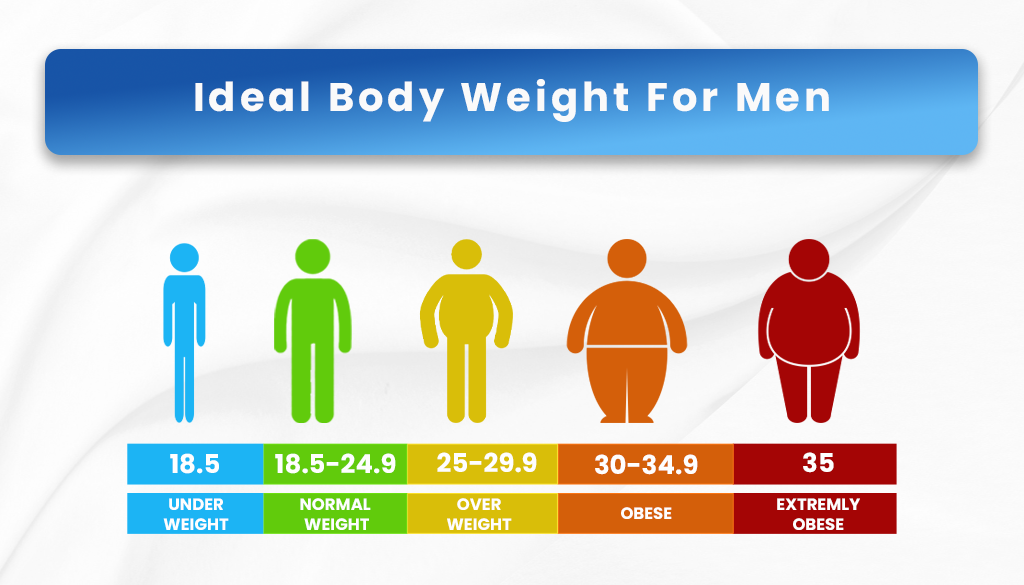
These numbers rely on Body Mass Index (BMI) and are adjusted for lean muscle mass. However, muscle mass, bone density, and activity level can make a huge difference.
Key Notes:
- Prioritizes avoiding underweight classifications while allowing modest flexibility for muscle mass.
- Used in clinical contexts where underestimating weight risks underdosing medications.
Formula used:
- Devine: 50 KG + 2.3 kg/inch over 5 feet
- Hamwi: 48 KG + 2.7kg/inch over 5 feet
Conversions: 1 kg = 2.20462 lb; values rounded to whole numbers
Limitations:
- It doesn’t account for body fat percentage or athletic builds (e.g., a muscular 6’0″ man may exceed the Hamwi range but remain healthy)
- For general health, use BMI (18.5-24.9)
How to Use These Weight Ranges?
Your ideal body weight should be a guideline, not a strict rule. Everyone’s body is unique, and factors like genetics, muscle composition, and lifestyle play a role. Here’s how to use these ranges effectively:
-
- Personalize Your Goals: Your ideal weight might be higher if you’re muscular. The lower end may be more realistic if you have a leaner frame.
- Look Beyond the Scale: Your body fat percentage and muscle mass are better health indicators than weight alone.
- Consult a Professional: A dietitian or nutritionist can help determine your healthiest weight based on your body type, age, and lifestyle.
Tips for Maintaining Ideal Body Weight
To maintain a healthy weight, improve your balanced diet, exercise regularly, sleep properly, manage your diet, and monitor your weight accordingly.
Balanced Diet and Nutrition
- Focus on whole, nutrient-rich foods like lean proteins, whole grains, fruits, and vegetables.
- Control portion sizes and maintain a balanced intake of macronutrients (protein, carbs, and fats).
- Keep portion sizes in check. Overeating healthy food is still overeating.
- Avoid consumption of processed foods, sugary drinks, and alcohol.
Get an Expert Weight and Wellness Support at Clinic One!
Regular Physical Activity
- Aim for at least 150 minutes of mild exercise per week (or 75 minutes of intense exercise), which will help you to lose weight.
- Combine cardio workouts (running, cycling, swimming) and strength training to build muscle and boost metabolism.
- Staying active throughout the day by simple activities like walking, stretching, or using the stairs, and avoiding prolonged sitting makes a difference.
Lifestyle and Habit Changes
- Prioritize getting 7-9 hours of sleep. Rest supports metabolism and weight management.
- Staying hydrated helps regulate hunger and digestion.
- Manage your stress, which in turn can help you reduce overeating and weight gain.
Regular Monitoring and Adjustments
- Check your weight once a week rather than daily to track trends without obsessing.
- If your weight fluctuates, adjust your diet and exercise routines accordingly.
- Get professional guidance if needed; personalized advice is always better than guesswork.
Conclusion
Your ideal body weight is more than just a number. It’s a reflection of your health, lifestyle, and body composition. Use these weight ranges as a guideline, not a strict rule, and focus on building healthy habits that work for you. Additionally, if you’re unsure about your weight goals, get personalized advice from a healthcare professional.
Clinic One has a dedicated team that makes staying healthy easier with personal weight management plans and expert advice. We can guide you on nutrition, fitness, and overall health to reach your goals. So, take the first step toward a healthier you with our care and expertise. Book an appointment today!!
FAQs
What is a normal male weight in kg?
A man’s normal weight varies depending on height, age, body composition, and overall health. An adult male’s average weight typically ranges between 60 kg to 80 kg.
How can men lose weight fast in two weeks?
To lose weight quickly in two weeks, focus on diet, exercise, and lifestyle changes. Here are some simple tips:
- Eat fewer calories than you burn. Choose healthy, low-calorie foods like veggies, lean proteins, and whole grains.
- Do high-intensity workouts or strength training to burn fat and build muscle.
- Cut down on carbs, sugars, and processed foods.
- Drink plenty of water to stay full and boost your metabolism.
- Sleep 7-8 hours nightly to control hunger and support weight loss.
How do you calculate the ideal body weight for a man?
Calculating the ideal body weight for a man can be done using a few common methods. Here’s a simple formula:
- Devine Formula: Ideal Body Weight (kg) = 50 + 0.9 × (Height in cm – 152)
- Hamwi Formula: Ideal Body Weight (kg) = 48 + 2.7 kg per inch over 5 feet
Is 75kg a good weight for a man?
It depends on his height, body type, and health.
For example:
- A man who is 1.75 meters (5’9”) tall and weighs 75 kg has a BMI of 24.5, which is healthy.
- But for a man who is 1.65 meters (5’5”) tall, 75 kg gives a BMI of 27.5, which is overweight.
Weight alone doesn’t tell the whole story; factors like muscle mass and body fat matter, too. For a clear answer, it’s best to consult a doctor.

![Best Cardioloigist in Kathmandu, Nepal | Dr. Dipak Raj Baral [NMC No. 5626]](https://clinicone.com.np/wp-content/uploads/2026/09/Best-cardiologist-in-kathmandu-Nepal.webp "Best Cardioloigist in Kathmandu, Nepal | Dr. Dipak Raj Baral [NMC No. 5626]")