
Ideal Body Weight for Women According to Height
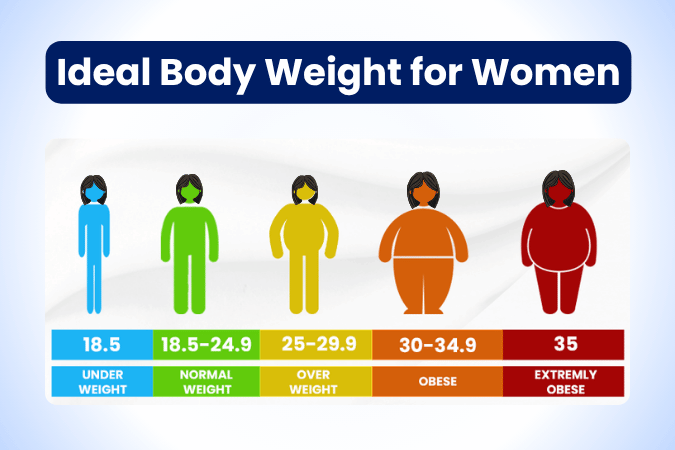
According to the National Health and Nutrition Examination Survey (NHANES), 27.5% of women are overweight, and 11.5% have severe obesity. These data highlight the importance of understanding their ideal body weight ranges. Hence, let’s explore detailed ideal weight ranges for women in both kilograms (kg) and pounds (lb), along with a simple formula to measure it.
We’ll also discuss some tips on maintaining a healthy weight. But before that, let’s discuss what ideal body weight is.
Is your weight impacting your health? Book a consultation with our nutritionists.
What is Ideal Body Weight?
Ideal body weight (IBW) is the weight at which your body functions effectively, reducing health risks like diabetes, heart disease, joint problems, and other issues. It’s not the same for everyone. It varies based on factors like age, height, muscle mass, and overall body composition. Unlike general weight ranges, IBW focuses on what’s healthiest for your unique body, helping you feel energised and confident.
How to Calculate Your Ideal Body Weight?
You can calculate your ideal body weight using two popular formulas: the Devine formula and the Hamwi formula. Both are simple and widely used, but the Devine formula is a highly used method.
Devine formula
- In kilograms (kg): 45.5 + 2.3 (height in inches – 60)
- In pounds (lb): 100 + 5 (height in inches – 60)
For example, if you’re 5’2” (62 inches) tall:
-
- To calculate your ideal weight in KG: “45.5 + 2.3 (62 – 60) = 45.5 + 2.3 * 2 = 45.5 + 13.8 = 50.1 kg”
- To calculate your ideal weight in LB: “100 + 5 (62 – 60) = 100 + 5 * 2 = 100 + 30 = 110 lb”
Hamwi formula
- In kilograms (kg): 45 + 2.2 (height in inches – 60)
- In pounds (lb): 100 + 6 (height in inches – 60)
Example: If you’re 5’4” (64 inches) tall:
-
- To calculate your ideal weight in KG: “45 + 2.2 (64 – 60) = 45 + 2.2 * 4 = 45 + 8.8 = 53.8 kg”
- To calculate your ideal weight in LB: “100 + 6 (64 – 60) = 100 + 6 * 4 = 100 + 24 = 124 lb”
Note: This is a rough estimate; other factors, such as muscle mass and body fat percentage, also matter.
Ideal Body Weight Range for Women (in KG and LB)
The ideal body weight chart for women ranges based on height:
| Height (Feet & Inches) | Height (Centimetres) | Weight Range (Devine) | Weight Range (Hamwi) | ||
|---|---|---|---|---|---|
| KG | Lb | KG | Lb | ||
| 5’0” | 152.4 | 45.5 – 53 kg | 100 – 118 Lb | 45 – 52 kg | 100 – 116 Lb |
| 5’1” | 154.94 | 47.8 – 55 kg | 105 – 122 Lb | 47.2 – 54.2 kg | 106 – 112 Lb |
| 5’2” | 157.48 | 50 – 57.3 kg | 110 – 128 Lb | 49.4 – 56.4 kg | 112 – 128 Lb |
| 5’3” | 160.02 | 52.4 – 60 kg | 115 – 133 Lb | 51.6 – 58.5 kg | 118 – 134 Lb |
| 5’4” | 162.56 | 54.7 – 62 kg | 120 – 138 Lb | 53.8 – 60.5 kg | 124 – 140 Lb |
| 5’5” | 165.1 | 57 – 64.5 kg | 125 – 143 Lb | 56 – 63 kg | 130 – 146 Lb |
| 5’6” | 167.64 | 59 – 66.5 kg | 130 – 147 Lb | 58.2 – 65 kg | 136 – 152 Lb |
| 5’7” | 170.18 | 61.6 – 68.8 kg | 135 – 153 Lb | 60.4 – 67.5 kg | 142 – 158 Lb |
| 5’8” | 172.72 | 63.8 – 70.9 Kg | 140 – 158 Lb | 62.6 – 69.6 Kg | 148 – 164 Lb |
| 5’9” | 175.26 | 66.2 – 74 kg | 145 – 163 Lb | 64.8 – 71.5 kg | 154 – 170 Lb |
| 5’10” | 177.8 | 68.5 – 76 kg | 150 – 168 Lb | 67 – 74 kg | 160 – 176 Lb |
| 6’0” | 182.88 | 73.1 – 81 kg | 160 – 178 Lb | 71.4 – 78.5 kg | 172 – 188 Lb |
| 6’1” | 185.42 | 75.4 – 83 kg | 165 – 183 Lb | 73.6 – 80.5 kg | 178 – 194 Lb |
| 6’2” | 187.96 | 77.7 – 85 kg | 170 – 188 Lb | 75.8 – 83 kg | 184 – 200 Lb |
| 6’3” | 190.5 | 80 – 87.2 kg | 175 – 193 Lb | 78 – 85 kg | 190 – 206 Lb |
| 6’4” | 193.04 | 82.3 – 90 kg | 180 – 198 Lb | 80.2 – 87 kg | 196 – 212 Lb |
| 6’5” | 195.58 | 84.6 – 92 kg | 185 – 203 Lb | 82.5 – 89.5 kg | 202 – 218 Lb |
Notes:
- These formulas are estimates and do not account for muscle mass, bone structure, or fat distribution.
- A healthy weight is best determined in consultation with a healthcare provider, considering overall health, fitness level, and individual goals.
- Focus on body composition (muscle vs. fat) and overall well-being rather than just weight.
Achieve Your Health Goals with Expert Women’s Wellness Care at Clinic One!
How to Use These Weight Ranges
Your ideal body weight is a starting point, not a strict rule. Each person has a different body, and factors like genetics, muscle composition, and lifestyle play a role. Here’s how to use these ranges effectively:
- Personalise Your Goals: If you’re muscular, your ideal weight might be higher. If you have a leaner frame, aim for the lower end.
- Look Beyond the Scale: Focus on body fat percentage, muscle mass, and how you feel rather than just the number on the scale.
- Consult a Professional: A dietitian or healthcare provider can help you determine the healthiest weight for your body type and lifestyle.
Tips for Maintaining Ideal Body Weight
Focus on a balanced diet rich in whole foods and pair it with regular exercise, including cardio and strength training. Prioritise sleep, hydration, and stress management while monitoring progress to stay on track.
Balanced Diet and Nutrition
- Eat whole, nutrient-rich foods like lean proteins, whole grains, fruits, and vegetables.
- Control portion sizes and balance your intake of protein, carbs, and fats.
- Limit processed foods, sugary drinks, and alcohol.
Regular Physical Activity
-
Aim for at least 150 minutes of moderate exercise (like brisk walking) or 75 minutes of intense exercise (like running) each week can help you lose weight.
- Combine cardio workout with strength training to build muscle and boost metabolism.
- Stay active throughout the day by walking, stretching, or taking the stairs, and avoid sitting too much.
Lifestyle and Habit Changes
- Prioritise 7-9 hours of sleep each night to support metabolism and weight management.
- Stay hydrated to regulate hunger and digestion.
- Manage stress to avoid emotional eating and weight gain.
Regular Monitoring and Adjustments
- Weigh yourself once a week to track trends without obsessing over daily fluctuations.
- Adjust your diet and exercise routine if your weight changes significantly.
- Seek professional guidance if you’re unsure about your weight goals.
Conclusion
Your ideal body weight is a tool for health, not just a number. Use the weight ranges as a guideline, but focus on building habits that make you feel strong, energised, and confident. If you’re unsure where to start, consult a healthcare professional for personalised advice.
Clinic One has a dedicated team that makes staying healthy easier with personal weight management plans and expert advice. We can guide you on nutrition, fitness, and overall health to reach your goals. So, take the first step toward a healthier you with our care and expertise. Book an appointment today!!
FAQs
What is a good body weight for women?
A “good” or healthy body weight for women generally falls within the Body Mass Index (BMI) range of 18.5 to 24.9, which indicates a weight that’s proportional to height and linked to lower health risks. You can use the Devine or Hamwi formulas to estimate an ideal weight
How to calculate the ideal body weight for a female?
Use formulas:
- Devine formula
In kilograms (kg): 45.5 + 2.3 (height in inches – 60)
In pounds (lb): 100 + 5 (height in inches – 60)
- Hamwi formula
In kilograms (kg): 45 + 2.2 (height in inches – 60)
In pounds (lb): 100 + 6 (height in inches – 60)
Is 70kg normal for a woman?
Normal weight depends on your height and body mass index. If your height is 5’10” and your BMI is 18.5 – 24.9, then 70kg is within the healthy range. For shorter heights, 70 kg may be overweight.
What kg is underweight for a female?
A BMI below 18.5 indicates a person is underweight. For example, a 5’5” woman weighing under 50kg may be underweight.

![Best Cardioloigist in Kathmandu, Nepal | Dr. Dipak Raj Baral [NMC No. 5626]](https://clinicone.com.np/wp-content/uploads/2026/09/Best-cardiologist-in-kathmandu-Nepal.webp "Best Cardioloigist in Kathmandu, Nepal | Dr. Dipak Raj Baral [NMC No. 5626]")